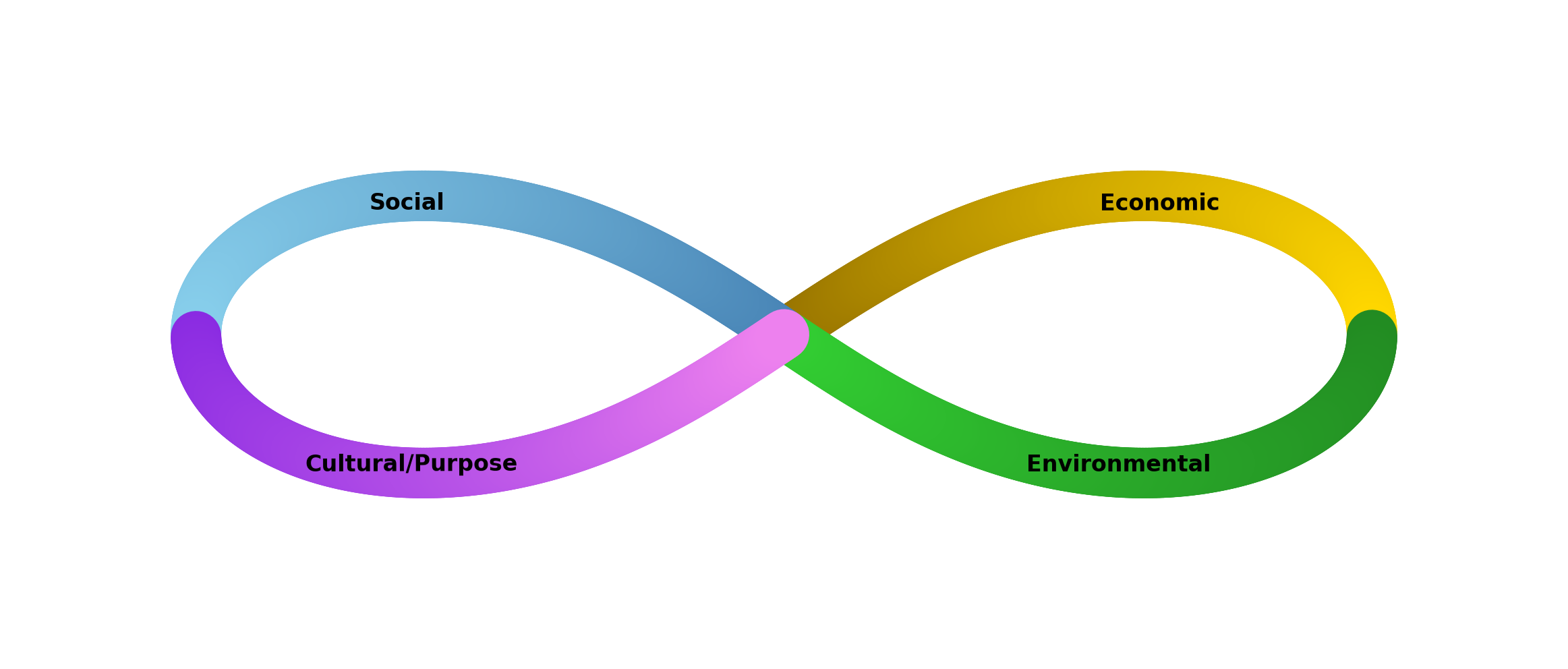
Core Philosophy - Multidimensional Sustainability Intelligence
Core Philosophy: Multidimensional Sustainability Intelligence
The Problem We Solve
Traditional sustainability assessments suffer from critical limitations:
- One-Dimensional Thinking: Focus on environmental OR social OR economic factors in isolation
- Siloed Decision-Making: Different teams use different metrics and data sources
- Measurement Gaps: Missing dimensions like connectedness and systemic effects
- No Context: Global frameworks applied without regional adaptation
- Limited Integration: Sustainability efforts disconnected from business operations
- Slow Learning: Quarterly or annual reviews instead of continuous improvement
Our Philosophy
The SDGL-SaaS Platform is built on three core principles:
1. Multidimensional Assessment (ESGETC)
Sustainability is inherently complex and multidimensional. We evaluate performance across six interconnected dimensions:
| Dimension | Focus | Why It Matters |
|---|---|---|
| Economic | Job creation, local value, financial stability | Enables sustainable business models |
| Social | Equity, community safety, civic participation | Ensures inclusive development |
| Environmental | Emissions, resources, biodiversity, resilience | Protects planetary boundaries |
| Governance | Transparency, accountability, stakeholder engagement | Builds trust and legitimacy |
| Technological | Digital infrastructure, innovation adoption, cybersecurity | Enables modern solutions |
| Connectedness | Network density, collaboration, information flow | Amplifies collective impact |
Unlike single-issue frameworks, multidimensional assessment reveals:
- How actions in one dimension affect others (trade-offs and synergies)
- Where real constraints and opportunities are located
- Which interventions create system-wide transformation
2. Triple Materiality Assessment (3D Decision-Making)
Traditional materiality matrices miss critical insights. We assess three lenses simultaneously:
Financial Materiality: What impacts business performance and shareholder value?
Impact Materiality: What affects stakeholders and communities?
Systemic Materiality: What shapes system-wide transformation and resilience?
This creates a 3D decision space with 8 octants, enabling organizations to:
- Quickly execute high-impact, low-effort initiatives (Quick Wins)
- Transform systems through critical leverage points
- Build resilience by addressing systemic vulnerabilities
- Engage stakeholders by demonstrating triple-bottom-line thinking
3. Localization with Geographic Context
SDG Localization means adapting global goals to regional contexts. Our platform enables:
- Geographic Data Integration: Climate, biodiversity, economic data by region
- Cultural Narrative & Regional Context: Local stakeholder perspectives shape priorities
- Regional Benchmarking: Compare against similar organizations in your region
- Country-Specific Regulation: Compliance with local reporting requirements
- Multi-Scale Assessment: Global/national/regional/local simultaneously
Organizations in rural Kenya face different sustainability challenges than urban Singapore. Our platform adapts to each context.
4. AI-Assisted PDCA Sustainability Journey
Continuous improvement requires discipline. We embed Plan-Do-Check-Act (PDCA) cycles with AI assistance:
Plan: AI analyzes baseline data and recommends goals aligned with SDGs and organizational capacity
Do: Track implementation progress with IoT sensors, staff updates, and integrated systems
Check: Automated anomaly detection and benchmark comparison surfaces issues early
Act: AI synthesizes learning and recommends next-cycle adjustments
The result: Organizations improve 3-5x faster with data-driven decision-making.
5. Hexa-Helix Multi-Sector Collaboration
Sustainability challenges are too big for any single organization. The platform enables Hexa-Helix Partnerships connecting:
- Academia - Research, innovation, training
- Government - Policy, regulation, infrastructure
- Civil Society - Community voice, advocacy, accountability
- Business - Scale, efficiency, investment
- Community - Ground truth, participation, stewardship
- Media - Narrative, learning, transparency
This creates network effects where collective impact far exceeds individual contributions.
Implementation Philosophy
Our approach balances rigor with pragmatism:
✅ Evidence-Based:
Decisions grounded in data, not ideology. We use validated frameworks (SASB, GRI, SDG framework, Meadows leverage points).
✅ Iterative:
Perfect is the enemy of good. Start with imperfect data, improve continuously, adapt as you learn.
✅ Systemic:
Address root causes, not symptoms. Look for feedback loops, unintended consequences, transformation potential.
✅ Inclusive:
No one has all the answers. Stakeholder engagement, consensus-building (Delphi method), and co-design are built in.
✅ Localized:
One size doesn’t fit all. Adapt frameworks to regional cultures, capacities, and opportunities.
✅ Action-Oriented:
Assessment without action is academic exercise. Platform moves quickly from insight to implementation.
Key Differentiators
Versus Traditional Consulting
- Faster: AI-generated insights vs. months of analysis
- Cheaper: SaaS model vs. expensive consultants
- Continuous: Quarterly decision-making vs. annual strategy updates
- Collaborative: Multi-stakeholder engagement vs. elite expert panels
Versus One-Dimensional SaaS Tools
- Comprehensive: 6 dimensions vs. 2-3 isolated metrics
- Contextualized: Regional adaptation vs. generic global framework
- Systemic: Understands interconnections vs. siloed analysis
- Collaborative: Multi-sector partnerships vs. single-organization focus
Versus DIY Spreadsheets
- Scalable: Handle 1000s of organizations vs. dozens
- Intelligent: AI-powered recommendations vs. manual analysis
- Connected: Discover and collaborate with partners vs. working alone
- Auditable: Full version control and audit trail vs. “mystery spreadsheets”
The Sustainable Development Goals (SDGs)
Our platform directly enables localization of all 17 SDGs:
- SDG 1-6: Poverty, hunger, health, education, water, sanitation
- SDG 7-9: Energy, work, infrastructure, innovation
- SDG 10-13: Inequality, consumption, climate, life in water
- SDG 14-16: Life on land, peace, partnerships
- SDG 17: Partnerships for the goals ← Our core focus
Every assessment, goal, and action links back to specific SDG targets, ensuring alignment with global priorities while maintaining local relevance.