Glossary
Glossary: Comprehensive Terminology
Core Sustainability Frameworks
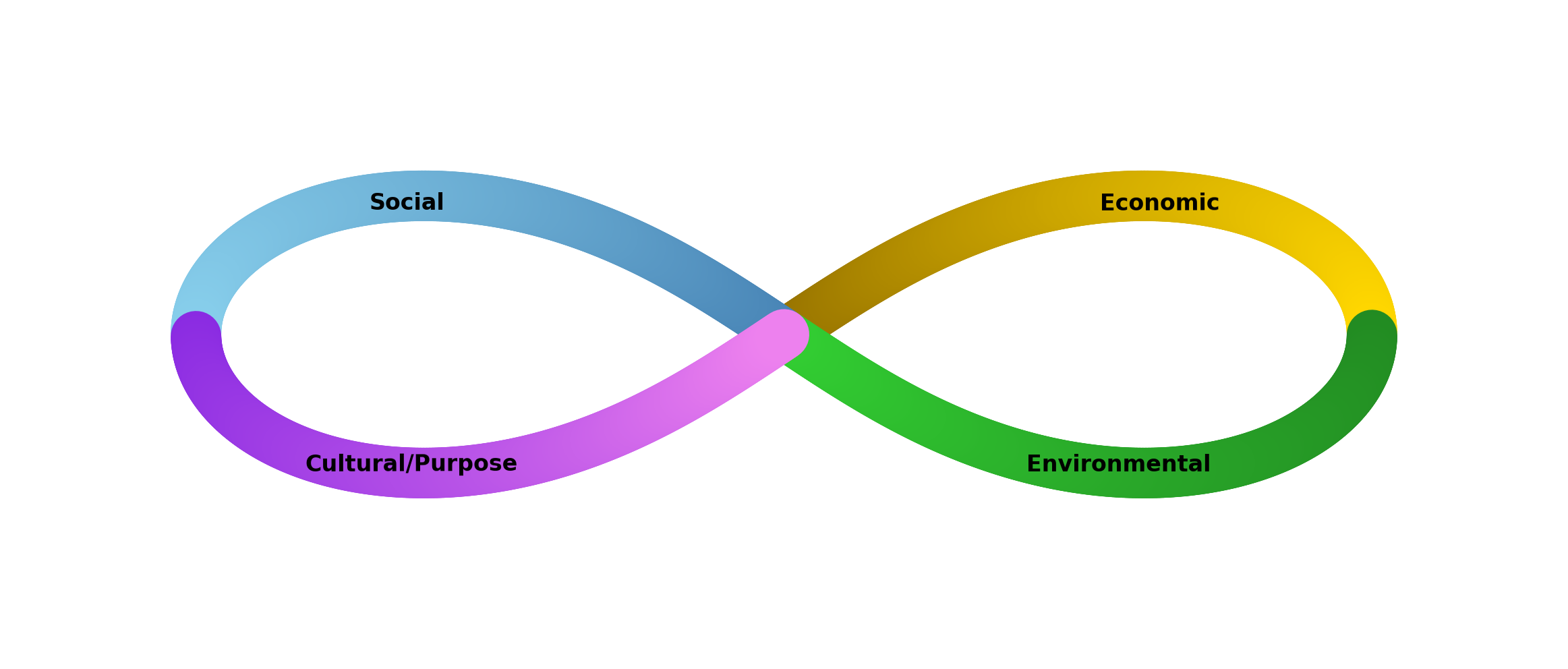
ESGETC Framework - Eight-dimensional holistic assessment framework: Environmental (climate, ecology, resources), Social (equity, wellbeing, culture), Governance (transparency, accountability, ethics), Economic (financial sustainability, value creation), Technological (innovation, capability), Connectedness (relationships, partnerships, systems thinking). Used as core lens across platform.
Triple Materiality Assessment - Three-part perspective on what matters: Financial Materiality (issues affecting financial performance), Impact Materiality (issues organization’s activities impact), Systemic Materiality (risks from broader system dependencies). Visualized as 3D octant with 8 distinct decision zones.
UN SDG (Sustainable Development Goals) - 17 global development priorities adopted by UN member states to achieve better future by 2030. SDGs: No Poverty, Zero Hunger, Good Health, Quality Education, Gender Equality, Clean Water, Affordable Energy, Decent Work, Industry Innovation, Reduced Inequality, Sustainable Cities, Responsible Consumption, Climate Action, Life Below Water, Life on Land, Peace & Justice, Partnerships.
SDG Localization - Process of contextualizing global SDG targets to specific geographic, economic, social, and political context. Recognizes that 2030 target for Poverty in Sub-Saharan Africa differs from Nordic countries; same goal, different implementation.
ESG (Environmental-Social-Governance) - Traditional three-part sustainability framework focusing on non-financial performance; foundational concept expanded by ESGETC to include economic, technological, and systems dimensions.
Assessment & Measurement Methodologies
Baseline Assessment - First comprehensive evaluation establishing current organizational state; sets comparison point for measuring progress; typically requires 2-3 weeks of data collection and stakeholder input.
Benchmarking - Comparative analysis between organization and peer group (by sector, size, geography, maturity level); typically shown as percentile ranking (e.g., “75th percentile” means performing better than 75% of peers).
Materiality Analysis - Structured process identifying which issues matter most to organization and stakeholders; combines internal importance (what affects business?) with external importance (what affects society?); produces prioritized list of material topics.
Anomaly Detection - Machine learning technique identifying unusual patterns or outliers in data; flags values that don’t match expected trends or peer norms; useful for data quality assurance and opportunity identification.
Scenario Modeling - What-if analysis testing how organizational metrics would change under different assumptions (e.g., “If energy costs increase 20%, what happens to profitability and emissions scores?”); supports strategic planning and risk management.
Hotspot Analysis - Systematic identification of priority areas requiring attention; combines severity (how bad is issue?), impact (how many people/systems affected?), and tractability (how solvable is it?); produces prioritized action list.
Trade-off & Synergy Analysis - Assessment of relationships between two initiatives or outcomes: trade-off = improvement in one requires sacrifice in another; synergy = improvements mutually reinforce each other. Helps avoid unintended negative consequences.
PDCA Cycle (Plan-Do-Check-Act) - Continuous improvement methodology: 1) Plan = set goals and strategies, 2) Do = implement, 3) Check = measure and evaluate results, 4) Act = adjust and standardize improvements; cycle repeats creating continuous learning.
AI-Assisted PDCA - Enhancement of PDCA cycle where machine learning provides recommendations at each stage: plan phase suggests evidence-based actions; do phase flags execution risks; check phase automatically calculates impact; act phase prioritizes next improvements.
Stakeholder Engagement Models
Hexa-Helix Partnership - Collaboration model engaging six sectors: Academia (research/education), Business (market leadership), Government (regulation/resources), Civil Society (advocacy/values), Media (communication), Communities (lived experience); recognizes each sector brings critical perspective and capability.
LCU-SDGL (Local Consortiums of Universities) - Network of universities committed to localizing SDGs in their regions; Universities as connectors between government, business, community, and international development; model pioneered in Global South.
Stakeholder Advisory Boards (SABs) - Formal governance structure including external stakeholders (community leaders, employee representatives, customer advocates, etc.) providing input on strategy, policies, and investments; typically meets quarterly.
Delphi Consensus Method - Structured decision-making process gathering expert opinions through multiple rounds of anonymous surveys with feedback; converges on group consensus while maintaining individual perspectives; useful for complex/contentious decisions; automated in platform.
Participatory Action Research (PAR) - Research methodology where community members actively participate in problem definition, solution design, testing, and learning; generates local knowledge and builds ownership; foundation for sustainable change.
Data Ecosystem & Integration
Production-Grade IoT Pipeline - Enterprise data collection system processing thousands of sensors/devices, ingesting 1M+ events weekly, handling data validation, deduplication, and real-time processing; built for reliability and automation.
NLP Entity Discovery - Natural Language Processing technique automatically identifying and classifying entities (organizations, materials, locations) from unstructured text (emails, reports, social media); enables automated data enrichment and knowledge extraction.
Federated Data Model - Database architecture where data remains in original location (subsidiary’s system, regional database, asset location) while being accessed and analyzed through unified interface; preserves data sovereignty while enabling integrated analysis.
Supply Chain Traceability - Capability to track material/product journey from source through processing, distribution, to end-use; captures environmental/social impacts at each stage; critical for Scope 3 emissions and modern slavery risk.
Organic Waste Upcycling (OWU) - Agricultural/culinary waste transformation into valuable products (compost, biogas, protein, etc.); platform provides decision support for waste valorization pathways based on local conditions; specialized analytics for mushroom taxonomy and production.
Adaptive Intelligence Weighting - Machine learning model that learns which indicators best predict outcomes for organizations like yours; automatically adjusts weights given to indicators improving predictive accuracy and personalization.
Governance & Compliance Frameworks
GDPR (General Data Protection Regulation) - European Union law protecting personal data; grants individuals rights: access data about them, correct errors, delete data (right to be forgotten), object to processing, data portability; organizations must have lawful basis and consent for processing.
CCPA (California Consumer Privacy Act) - U.S. privacy law giving California residents similar rights to GDPR; prohibits sale/sharing of personal data; requires disclosures about data collection; applies to for-profits collecting California residents’ data.
LGPD (Lei Geral de Proteção de Dados) - Brazilian privacy law similar to GDPR; protects personal data, grants data subject rights, establishes data controller responsibilities; applies globally to Brazilian residents’ data.
SOC 2 Type II - Audit standard for cloud service providers; independent auditors verify controls in five trust service categories: Security (prevent unauthorized access), Availability (system operational when needed), Processing Integrity (transactions complete accurately), Confidentiality (sensitive data private), Privacy (complies with privacy principles); annual audit cycle.
ISO 27001 - International standard for information security management systems; certifies organization has controls for asset management, access control, cryptography, physical security, operations, change management, incident response, business continuity, supplier management; requires continuous improvement.
FedRAMP (Federal Risk and Management Program) - U.S. government program authorizing cloud services for federal use; ensures compliance with federal security standards; certification required for federal agency contracts.
Responsible AI Governance - Framework ensuring AI systems are: transparent (explainable), fair (not biased), accountable (traceable), secure (protected from misuse). Platform includes bias testing, fairness audits, and human oversight mechanisms.
Audit Trail - Immutable cryptographic record of all system access, data modifications, and administrative actions; captures who did what when why; essential for compliance, security investigation, and fraud detection; typically retained 7 years.
ESG Regulatory & Reporting Standards
GRI (Global Reporting Initiative) - Most widely used global sustainability reporting standards; covers 300+ indicators organized by performance areas; provides framework for comprehensive sustainability disclosure without prescribing specific targets.
SASB (Sustainability Accounting Standards Board) - Industry-specific standards for material ESG issues affecting financial performance; focused on investor-relevant sustainability; covers 11 sectors with sector-specific metrics aligned with financial materiality.
TCFD (Task Force on Climate-Related Financial Disclosures) - Framework for disclosing climate-related financial risks and opportunities; organized around four pillars: governance, strategy, risk management, metrics/targets; used by investors for climate risk assessment.
CSRD (Corporate Sustainability Reporting Directive) - European Union regulation requiring large companies to disclose detailed sustainability information; double materiality focus (what affects business AND what business affects); phased implementation 2023-2028.
CDP Climate Change Disclosure - Questionnaire system where organizations disclose climate risks, emissions, and mitigation strategies to investors; provides benchmark data and public rankings; covers climate, water, forest lands.
Integrated Reporting - Holistic reporting approach showing how strategy, governance, performance, and prospects create value over time; integrated report tells story connecting financial and non-financial performance.
B Corp Impact Assessment - Comprehensive certification assessing company’s impact across Governance, Workers, Customers, Community, Environment; requires meeting performance threshold, legal accountability, and transparency; globally recognized impact credibility.
Organizational & Partnership Structures
Multi-Tenancy - Software architecture serving multiple organizations (tenants) from single instance; complete data isolation between organizations; enables shared infrastructure with privacy and customization; more scalable than single-tenant models.
Enterprise Account Hierarchy - Organizational structure for large entities where parent organization oversees multiple subsidiary/child organizations; enables consolidated reporting and governance while maintaining operational independence and confidentiality as needed.
Partner Network/Ecosystem - Network of complementary service providers (consultants, auditors, technology partners) pre-vetted and available through platform; enables customers to extend capabilities without expensive vendor selection process.
Financial & Valuation Terms
ESGETC Investment Screening - Application of ESGETC framework to investment/lending decisions; assesses 6 dimensions of portfolio holdings; enables investors to allocate capital toward sustainable outcomes; emerging alternative to traditional ESG scoring.
Impact Quantification - Process of assigning financial value to non-financial outcomes (e.g., carbon emissions avoided worth $X, lives improved worth $Y); enables financial teams to incorporate sustainability into business cases.
Cost-Benefit Analysis - Structured comparison of intervention costs (time, money, resources) versus benefits (quantified and intangible); shows whether intervention justified; platform automates calculation for action plans.
Return on Investment (ROI) - Financial metric showing profit relative to investment (Profit/Investment × 100%); used to compare alternatives and justify spending; sustainability ROI increasingly linked to operational efficiency, risk reduction, reputation.
Organizational Change & Maturity
Organizational Maturity Level - Assessment of organization’s capability and commitment to sustainability; levels typically: Exploring (early stage, learning), Developing (systems in place, scaling), Leading (comprehensive integration, innovation), Driving (industry catalyst, transformation); platform assesses and tracks progression.
Change Management - Structured approach to organizational transitions; ensures stakeholder buy-in, minimizes resistance, builds capability, embeds new ways of working; critical success factor for sustainability integration.
Readiness Assessment - Evaluation of organization’s preparedness for major change; assesses awareness, skills, resources, leadership commitment, cultural fit; identifies gaps and support needs before major initiative.
Capability Building - Systematic development of organizational skills and capacity needed for sustainability integration; includes training, coaching, peer learning, tool access; recognizes transformation takes time and support.
Regional & Agricultural Specialization
Localization (Geographic) - Adaptation of global standards, best practices, or governance to regional context; recognizes differences in economic development, institutional strength, cultural values, environmental conditions; enables more relevant and effective implementation.
Mushroom Taxonomy - Classification system for edible/medicinal mushroom species used in Organic Waste Upcycling; platform provides decision support for which species optimal for local waste streams, climate, market demand.
Agroforestry Systems - Agricultural practice integrating trees with crops/livestock; produces multiple ecosystem services (food security, climate mitigation, biodiversity, soil health); platform tracks impacts across environmental and livelihood dimensions.
Technical Infrastructure
API (Application Programming Interface) - Software interface enabling different systems to communicate; platform provides REST API for integrations, webhooks for event notifications, GraphQL for flexible queries.
Microservices Architecture - Software design where application built as collection of independent services (assessment engine, data pipeline, reporting, integrations); enables scalability, resilience, independent deployment; more complex than monolithic but more flexible.
Single Sign-On (SSO)/SAML - Authentication method where users log in once and gain access to multiple connected systems without re-entering credentials; SAML is standard protocol; enables enterprise-grade security and user management.
Encryption Standards - AES-256 (symmetric encryption for data at rest), TLS 1.2+ (for data in transit), RSA-2048+ (asymmetric for key exchange); platform implements multiple encryption layers.
Rate Limiting - Technical control restricting API requests to prevent abuse (malicious overload) and ensure fair resource allocation; typical limit 1000 requests/hour; graceful degradation provides meaningful error messages.
Data Pipeline - Automated workflow extracting data from sources, transforming to standard format, validating quality, loading to warehouse; production-grade pipelines handle errors, retries, monitoring; critical for real-time analytics.
Webhook - Automated notification where source system sends HTTP POST to destination system when event occurs; enables real-time integration vs. polling; Requires destination to handle asynchronous updates and retries.
Decision Support Tools
3D Octant Visualization - Three-dimensional visualization of materiality assessment; cube divided into 8 octants based on three binary dimensions (Financial × Impact × Systemic); each octant suggests different strategic response. Example: High-High-High issues are strategic imperatives; Low-Low-Low issues may be lower priority.
Risk/Opportunity Matrix - Two-dimensional plot with issues/opportunities positioned by likelihood (x-axis) and impact (y-axis); helps prioritize focus on high-likelihood, high-impact items; common management tool adapted for sustainability context.
Scenario Planning - Strategic planning approach exploring multiple possible futures; tests robustness of strategy against different scenarios; reveals unintended consequences and opportunities; more sophisticated than simple SWOT.
Performance & Capability Concepts
Predictive Analytics - Machine learning models forecasting future outcomes based on historical patterns; platform uses for predicting which interventions will succeed, where problems likely to emerge, when thresholds at risk of violation.
Causal Inference - Statistical technique distinguishing correlation from causation; answers “does X actually cause Y or just correlated?”; important for understanding what interventions actually drive improvement vs. coincidence.
Clustering Analysis - Machine learning grouping organizations by similarity; identifies peer groups with similar characteristics; enables customized benchmarking and targeted recommendations.
Time-Series Forecasting - Predicting future values of metric based on historical data; recognizes patterns (trends, seasonality, cycles); supports resource planning and target setting.
Not finding a term?
Email support@platform.com and we’ll add it to the glossary.